Toll Free: 866.905.6744 | Local: 845.652.5250
China Best Control Wire Manufacturers and Suppliers?
Choosing a control wire supplier in China requires more than comparing catalog prices. Reliable selection begins with construction details, factory evidence, and application experience. A suitable supplier should explain conductor materials, insulation grades, shielding options, temperature ratings, and bending limits clearly.
Details matter. A control wire may run beside a motor cable, pass through a moving chain, or operate inside a humid control cabinet. Each environment demands different protection. Copper purity, stranding quality, jacket consistency, and terminal compatibility can influence signal stability and service life. W. Edwards Deming, a respected quality-management expert, stated, “Quality comes not from inspection, but from the improvement of the production process.” This principle remains relevant to control wire manufacturing.
A dependable manufacturer should provide traceable test records, sample approvals, production photographs, and clear dimensional data. It should also explain how it controls conductor resistance, insulation thickness, voltage testing, and batch consistency. Certifications are useful, but paperwork alone is not proof. Ask for recent reports and verify whether they match the supplied model.
Factory scale can help. It does not guarantee engineering discipline. Some suppliers communicate well before payment, then respond slowly after delivery. That risk deserves attention. A strong supplier welcomes technical questions and documents limitations honestly. No cable fits every project.
This guide examines leading China-based control wire manufacturers and suppliers through product range, customization ability, quality systems, delivery performance, and technical support. The goal is practical comparison, not empty promotion. Some evidence may remain incomplete, so buyers should confirm critical specifications before placing an order.
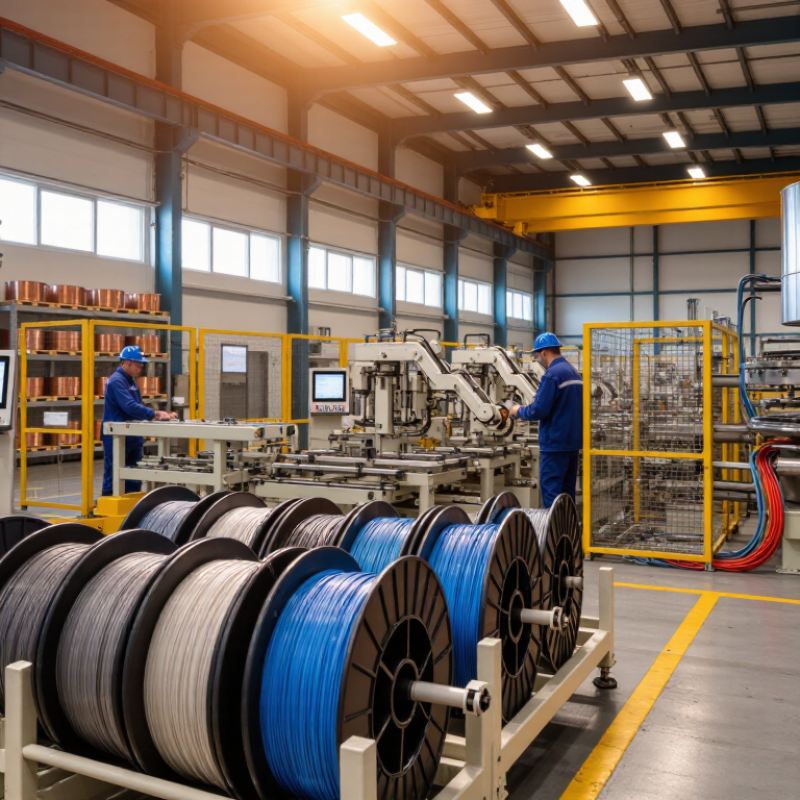
Control wire carries commands, feedback, and low-power signals between devices. It commonly connects sensors, relays, switches, programmable controllers, and motor-control panels. Unlike power cable, it usually handles smaller currents. Its value lies in accurate communication, not heat delivery.
In a factory, control wire may run from a proximity sensor to a controller, then to a contactor. One loose terminal can stop an entire production line. Shielded constructions help reduce electrical noise near variable-speed drives. Flexible insulation suits moving equipment, while oil-resistant jackets support workshops and processing areas. Selection should consider voltage, conductor size, temperature, bending, shielding, and flame performance. Simple choices can fail.
The International Energy Agency reported that global electricity demand is expected to grow by about 4% annually from 2024 through 2026. More electrical equipment means more monitoring and control points. The IEC 60228 standard also classifies conductors by resistance and construction, helping engineers compare cable performance. These references support disciplined specification, but they do not replace site testing. A product may meet a standard and still perform poorly in moisture, vibration, or crowded cable trays. That uncomfortable detail deserves attention. For Chinese manufacturers and suppliers, reliable technical documentation, traceable testing, and consistent conductor resistance matter more than attractive catalog language. Field verification remains necessary.
China Best Control Wire Manufacturers and Suppliers?
Key Standards and Specifications for Control Wires
Control wire selection starts with the application, not the price. IEC 60228 defines conductor classes, including solid and flexible constructions. IEC 60227 covers common PVC-insulated cables up to 450/750 volts. For industrial machinery, NFPA 79 also guides conductor identification, protection, and installation practices. IEC 60332-1-2 is important when flame resistance is required.
A 2024 Grand View Research report estimated the global industrial cables market at about USD 21.7 billion in 2023. It also projected continued growth through 2030, driven by automation and factory upgrades. This growth increases supplier choices, but quality can vary. Check conductor material, cross-sectional area, insulation temperature rating, voltage rating, shielding, oil resistance, and minimum bending radius. A thicker wire is not always safer. Excessive stiffness may create stress near terminals. No selection method is perfect.
Tips: Request a complete datasheet and test report. Confirm IEC 60228 conductor class. Check whether the stated temperature applies to continuous operation. For noisy control cabinets, compare braided shielding with foil shielding. Review flame, oil, and flexing requirements before approval. Suppliers should also provide batch traceability and dimensional tolerances. These small details often expose weak specifications.
| Evaluation Dimension | Typical Control Wire Requirement | Relevant Standard or Reference | Procurement and Inspection Points |
|---|---|---|---|
| Conductor Material | Annealed copper is the standard choice. Tinned copper is commonly selected for humid, corrosive, marine, or frequently handled applications. | IEC 60228; ASTM B3 and ASTM B8 may be used for copper wire and stranded conductors. | Confirm copper purity, conductor resistance, plating uniformity, and compliance with the specified conductor class. |
| Conductor Class and Flexibility | Class 1 is solid; Class 2 is stranded for fixed installations; Class 5 and Class 6 are more flexible for repeated movement or tight routing. | IEC 60228 conductor classes. | Match strand construction to the minimum bend radius, vibration level, terminal type, and installation movement. |
| Rated Voltage | Common low-voltage control wire ratings include 300/500 V and 450/750 V. The correct rating depends on the circuit and installation system. | IEC 60227 for certain PVC-insulated cables; IEC 60502-1 for many fixed low-voltage cable constructions. | The cable voltage rating must not be lower than the maximum system voltage, including transient or fault conditions where applicable. |
| Insulation Material | PVC is widely used for general-purpose control wiring. PE, XLPE, PUR, TPE, and low-smoke zero-halogen compounds are selected for specific temperature, chemical, flexibility, or fire-performance needs. | IEC 60227, IEC 60502-1, EN 50525 series, or the applicable product construction standard. | Check resistance to oil, UV exposure, chemicals, abrasion, water, and temperature before approving the insulation compound. |
| Operating Temperature | Typical PVC control wires are often specified around 70°C or 90°C, while XLPE and specialized thermoplastic constructions may support higher temperatures according to their certification. | The applicable cable standard and certification marking define the permitted conductor and ambient temperature limits. | Do not rely only on the maximum conductor temperature; verify ambient temperature, grouping, enclosure conditions, and derating requirements. |
| Cross-Sectional Area | Common metric sizes include 0.5, 0.75, 1.0, 1.5, 2.5, 4, and 6 mm². The appropriate size is determined by current, voltage drop, protection, and mechanical requirements. | IEC 60228 and the relevant national wiring or equipment standard. | Verify conductor resistance and ampacity using the installation method rather than selecting size from nominal current alone. |
| Number of Cores | Control cables may be supplied as single-core wires or multicore constructions with signal, power, spare, and protective-earth cores. | IEC, EN, or UL construction requirements applicable to the selected cable type. | Specify core count, core identification, conductor color sequence, numbering, lay length, and any drain or earth conductor. |
| Identification and Marking | Core colors, printed numbers, or color-and-number combinations are used to simplify installation and maintenance. | IEC 60445 for identification of equipment terminals and conductors; local wiring codes may add requirements. | Check print durability, contrast, spacing, meter marking, manufacturer traceability, voltage rating, and applicable certification marks. |
| Shielding and Electromagnetic Compatibility | Unshielded cables suit ordinary control circuits. Overall foil, braid, or combined shields are used where electromagnetic interference may affect signals. | IEC 60092-350, IEC 61000 series, or project-specific EMC requirements may apply depending on the installation. | Specify shield coverage, drain wire, transfer impedance where required, grounding method, and separation from high-power circuits. |
| Flame and Smoke Performance | Control wires may require vertical flame resistance, bunch-cable flame performance, low smoke, or halogen-free characteristics depending on the building or industrial environment. | IEC 60332 for flame tests, IEC 61034 for smoke density, and IEC 60754 for halogen-acid gas assessment. | Request the exact test level and report; a general “flame-retardant” statement is not sufficient for specification approval. |
| Oil, Water, and Chemical Resistance | Industrial control wiring may require resistance to mineral oil, coolants, cleaning agents, moisture, or outdoor weathering. | The applicable cable standard, compound specification, and customer test protocol determine the required resistance level. | Identify the exact chemical exposure, concentration, temperature, immersion time, and flexing condition before selecting the jacket material. |
| Mechanical Protection | Standard control wire is suitable for protected routing. Armoring, reinforced jackets, conduit, or cable trays may be needed for impact, crushing, rodents, or outdoor installation. | IEC 60502-1, IEC 60332, tray-cable requirements, and local installation codes as applicable. | Confirm minimum bend radius, tensile strength, crush resistance, impact resistance, and installation pulling tension. |
| Electrical Tests | Routine testing normally includes conductor resistance, insulation resistance, high-voltage withstand, continuity, and dimensional verification. | IEC 60228, IEC 60811, IEC 60502-1, or the relevant certification standard. | Require routine test records, batch traceability, test voltage and duration, sampling plans, and calibration status of test equipment. |
| Factory Documentation | A complete technical package should include datasheets, construction drawings, certificates, test reports, packing details, and inspection records. | Project specification, quality plan, applicable IEC/EN/UL requirements, and contractual inspection procedures. | Evaluate document consistency, revision control, batch identification, certificate scope, and whether reports correspond to the supplied construction. |
Note: The values and standards shown are common reference points for control-wire purchasing. Final requirements should be confirmed against the installation environment, applicable national regulations, equipment specifications, and the latest edition of the relevant standard.
China Best Control Wire Manufacturers and Suppliers?
How to Evaluate Chinese Control Wire Manufacturers
Evaluating a Chinese control wire manufacturer requires more than comparing online prices. Ask for factory details, production capacity, and verified product records. An experienced supplier should explain conductor materials, insulation compounds, voltage ratings, temperature ranges, and cable flexibility clearly.
Request samples from the same production line used for bulk orders. Check conductor size with a micrometer, inspect insulation thickness, and bend the wire repeatedly. Look for clean printing, consistent color, and firm terminal connections. Test reports should identify the tested model, date, equipment, and laboratory. Generic certificates are not enough.
A factory audit can reveal practical weaknesses. Review incoming material checks, extrusion controls, batch labeling, and final inspection procedures. Traceability matters when a shipment contains different reels. Ask how the supplier handles rejected products and corrective actions. A polished website proves little. Visit the facility, or use an independent inspection service. That mistake is costly.
Confirm packaging details before ordering. Moisture-resistant wrapping, accurate reel lengths, and visible labels reduce problems during installation. Discuss tolerances in writing, especially for conductor resistance and insulation diameter. Some suppliers communicate well before payment but respond slowly after production begins. Test their technical support with specific questions. A small trial order is sensible, although it may not reveal every long-term issue. Your evaluation should balance laboratory evidence, factory behavior, and the wire’s performance in actual control panels.
IEC 60228 maximum DC resistance benchmarks for Class 5 copper conductors at 20°C. Lower resistance generally indicates better electrical conductivity and process consistency.
When comparing suppliers, request independent test reports, conductor-size verification, batch traceability, insulation-voltage ratings, and resistance results that comply with the applicable IEC requirements.
China’s control-wire supply base covers several distinct supplier types. Cable specialists focus on copper conductors, insulation, shielding, and flexible jacket designs. Harness manufacturers add cutting, stripping, crimping, labeling, and connector assembly. Automation-focused factories often produce encoder cables, drag-chain cables, and industrial signal lines. Integrated suppliers can also support low-volume prototypes and repeat production.
Demand is broad. The International Energy Agency reported that China represented more than 60% of global electric car sales in 2023. This supports continued demand for compact, heat-resistant control wiring in vehicles and charging equipment. The same requirement appears in robotics, machine tools, elevators, and factory sensors. A capable manufacturer should offer PVC, PUR, XLPE, or PTFE insulation, depending on temperature and chemical exposure. Braided shielding and foil shielding help reduce electromagnetic interference.
Manufacturing depth matters more than a polished catalog. Look for conductor resistance testing, spark testing, tensile checks, bending trials, and 100% continuity inspection. ISO 9001 systems improve traceability, but certification alone proves little. Ask for batch records, sample reports, and cross-section images.
A factory with extrusion, braiding, molding, and automated crimping usually controls tolerances better. Still, larger capacity may reduce flexibility for custom orders. Buyers sometimes overlook minimum order quantities and tooling charges. That mistake is costly.
Industry forecasts from MarketsandMarkets continue to link industrial automation growth with rising demand for reliable cables and connectivity components. Exact forecasts differ, so verify specifications against the working environment, not only the supplier’s brochure.
Selecting the right control wire supplier starts with your project conditions. Define voltage, conductor size, insulation type, temperature range, and installation environment. A factory workshop may look impressive, but documented process control matters more. Ask for material certificates, test reports, and batch traceability. These records show whether copper purity, insulation thickness, and conductor resistance remain consistent.
Request samples before placing a large order. Test the wire under actual conditions, including bending, terminal fitting, and signal transmission. For outdoor panels, check moisture resistance and ultraviolet protection.
For industrial cabinets, confirm flame performance and operating temperature. Shielded wire may reduce interference near motors and variable-frequency equipment.
Small details matter. One overlooked bend radius can damage a cable during installation.
Evaluate the supplier’s technical support, production capacity, and response time. A reliable supplier should explain tolerances clearly, not promise everything without evidence. Review quality procedures, inspection equipment, packaging methods, and delivery records. Factory audits can reveal weak points that brochures hide. Price deserves attention, but the cheapest quotation may create replacement costs later. No supplier is perfect, including the one with excellent samples. Recheck performance after production begins, because consistency is harder than making one good sample.