Toll Free: 866.905.6744 | Local: 845.652.5250
Choosing China’s best wire cable manufacturers requires more than comparing prices on a supplier website. Global buyers need dependable materials, stable production, clear documentation, and responsive technical support. A cable may look excellent in a catalog. Its copper purity, insulation thickness, bending performance, and batch consistency tell a different story.
Valerio Battista, former chief executive of Prysmian Group, has expressed a useful industry principle: “Quality and reliability are the foundation of trust in cable systems.” That principle remains practical when evaluating Chinese manufacturers. Experienced buyers inspect factory capabilities, testing equipment, quality-control records, and export experience. They also verify compliance with project requirements, including voltage ratings, fire performance, environmental resistance, and applicable international standards.
Details matter. Ask how conductors are tested before stranding. Check whether production records identify each batch. Request samples with measured dimensions, not only polished photographs. Review packaging methods, especially for long-distance shipping and humid conditions. Confirm lead times with written production schedules.
Price still matters. It should not lead alone.
This guide examines manufacturers that serve global buyers across power, construction, telecommunications, industrial automation, and renewable-energy projects. It considers product range, customization, certifications, manufacturing capacity, delivery reliability, and after-sales service. No ranking is permanent. A factory may perform well on one project and disappoint on another. That uncomfortable possibility deserves attention. Careful verification, independent testing, and realistic specifications remain essential when selecting a wire cable partner from China.
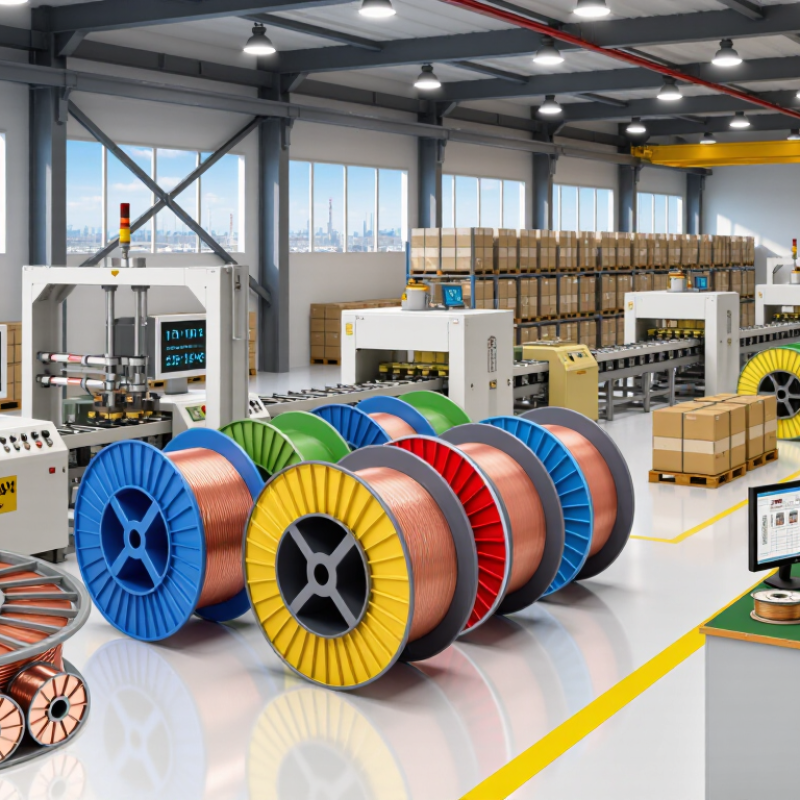
China’s wire and cable manufacturing sector serves global buyers through several specialized factory types. Building-wire manufacturers produce insulated copper or aluminum conductors for homes, offices, and commercial facilities. Their production lines usually focus on accurate conductor sizing, smooth insulation, and consistent color marking.
Power-cable manufacturers handle medium- and high-capacity products for factories, utilities, and infrastructure projects. They often operate stranding, insulation, shielding, and sheath-extrusion equipment under controlled conditions. Overhead-conductor factories make bare or covered conductors for transmission and distribution networks. Their quality checks may include tensile testing, dimensional inspection, and resistance measurement.
Other manufacturers focus on flexible cables, control cables, instrumentation cables, or custom assemblies. Flexible-cable producers use fine copper strands and carefully selected insulation for repeated movement. Control and instrumentation specialists pay closer attention to signal protection, pair identification, and shielding performance. Some factories offer original equipment manufacturing, while others develop complete products under their own technical systems.
Practical experience matters here. A polished sample can hide weak documentation. Buyers should review factory audits, test reports, material traceability, and production records. Ask how often they calibrate testing equipment. Ask for a sample length, not only a brochure. Small details matter.
Not every large factory is the best fit. A smaller specialist may understand unusual voltage, temperature, or installation requirements better. Still, capacity and delivery planning must be checked carefully. Mistakes happen when buyers compare price before confirming construction, standards, and testing scope.
Reliable supplier evaluation begins with technical standards, not attractive catalogs. Ask which IEC, EN, ASTM, or national standards govern the cable. The supplier should provide current test reports, material specifications, and clear product tolerances. Check conductor resistance, insulation thickness, tensile strength, voltage rating, and flame performance. Small details matter.
Request samples from the same production line used for bulk orders. A copper conductor should match the promised grade and cross-sectional area. Review batch numbers, production dates, and inspection records. Independent laboratory testing adds stronger evidence than internal claims. Confirm that testing equipment is calibrated and that reports identify the exact sample.
Factory capability also deserves close inspection. Look for controlled storage, clean extrusion areas, and visible quality checkpoints. Ask how nonconforming cable is isolated and corrected. Traceability should connect raw materials to finished coils. Export experience helps, but it does not replace technical proof. A polished factory tour can still hide weak process control. I have seen documentation look complete while basic measurements were missing. That gap deserves attention.
Evaluate communication under pressure. Can the supplier explain a failed test without vague promises? Can it provide a realistic production schedule and packaging plan? Check warranty terms, inspection access, and response times before placing a large order. Price is useful, but unexplained low pricing often signals thinner insulation, inconsistent copper, or incomplete testing. Supplier assessment is rarely perfect. Leave room for verification.
China’s strongest wire and cable suppliers are concentrated in several industrial regions. Jiangsu supports large cable plants near the Yangtze River Delta, with strong access to copper, machinery, ports, and testing services. Zhejiang is known for flexible wires, appliance cables, and smaller custom orders. Guangdong serves electronics and equipment manufacturers, where fast prototyping and dense supplier networks matter. Hebei offers strong capacity for steel wire, wire rope, and construction-related products.
Tips: Match the region to your product. Ask for conductor material, insulation type, voltage rating, temperature range, and application details. Request factory photos, test reports, sample lengths, and production records. A video audit helps, but it cannot replace an independent inspection.
Reliable sourcing requires more than comparing quotations. Experienced buyers should check drawing control, batch traceability, aging tests, and packaging protection. Look for clear tolerance data, not vague claims about quality. Ports in eastern and southern China can simplify shipping, although inland factories may offer better pricing. That advantage can disappear with extra trucking time. No cluster is perfect. Some suppliers communicate well but lack consistent testing. Others have advanced equipment but respond slowly to design changes. A practical evaluation should include samples, a pilot order, and documented corrective actions before regular production.
For global buyers, wire and cable quality control begins long before final inspection. A reliable manufacturer verifies copper or aluminum purity, conductor diameter, insulation compound, and production batch records. Incoming materials should carry test reports, but paperwork alone is not proof. Inspectors can compare conductor resistance with the declared size at controlled temperature. Small deviations matter. They can increase heat, voltage loss, or premature failure.
During production, testing should follow a documented plan. Continuous spark testing checks insulation for pinholes. Dimensional gauges measure insulation thickness around the cable, not only at one point. Finished samples may undergo tensile, elongation, bending, aging, flame, and voltage tests, depending on the cable type and destination. A serious factory keeps calibrated instruments, records operator names, and seals samples for traceability. We have found that missing calibration dates often reveal weak control, even when the product looks clean. Records matter.
Certification requirements differ by application and market. Buyers should request the applicable IEC, national, or project specification, then verify the certificate’s scope, validity, product model, and testing laboratory. Factory approval is not the same as product certification. Independent laboratory testing adds confidence, especially for large orders or safety-critical installations. Still, no checklist is perfect. Sampling can miss variation between batches, and certificates can become outdated after a material change. Contracts should define retesting, factory inspection, corrective actions, and document access before shipment. Clear records protect both sides.
China Best Wire Cable Manufacturers for Global Buyers
Global buyers should select Chinese wire and cable manufacturers through evidence, not attractive quotations. Request technical datasheets, conductor materials, insulation types, voltage ratings, and applicable test reports. Confirm whether reports match the exact product, not a similar model. A factory video helps, but an independent audit reveals more. Check production lines, laboratory equipment, operator training, and traceability records. Ask for samples with marked specifications and test them before approving volume production. Small details matter, such as jacket thickness and printing clarity.
Clear communication prevents expensive misunderstandings. Send drawings, tolerances, packaging requirements, annual demand, and destination standards in one controlled document. Discuss lead times honestly, including material purchasing and testing periods. A written quality agreement should define inspection methods, sampling levels, defect handling, and replacement responsibilities. Payment milestones can reduce risk, especially during the first order. Do not rely on informal promises.
Experienced buyers often schedule pre-shipment inspections. They compare cable dimensions, resistance, appearance, labeling, and packing against approved samples. Keep dated photographs and signed records. Factory communication may require patience because technical meanings can shift during translation. Use simple sentences and confirm decisions by email. I have seen projects delayed by one unclear tolerance. That mistake was avoidable. Still, no sourcing process is perfect. Review every shipment, record recurring defects, and adjust the supplier scorecard before placing the next order.
| Selection Dimension | What Global Buyers Should Assess | Practical Industry Reference | Documents or Evidence to Request |
|---|---|---|---|
| Product Scope | Confirm whether the manufacturer can supply the required wire or cable construction, voltage class, insulation material, conductor material, shielding, armoring, and jacket type. | Common export categories include building wire, flexible cord, control cable, instrumentation cable, power cable, photovoltaic cable, coaxial cable, and data cable. Product suitability depends on the application and installation environment. | Product catalogue, technical data sheets, construction drawings, and samples matching the requested specification. |
| Conductor Requirements | Check conductor material, class, cross-sectional area, stranding, resistance, and conductor diameter. | Copper and aluminium are widely used. IEC 60228 defines conductor classes and maximum DC resistance values for many cable conductors. The required conductor class should match the intended installation and flexibility level. | Conductor resistance test report, material declaration, strand-count details, and a cross-sectional inspection record. |
| Voltage and Temperature Rating | Match the cable voltage rating and maximum conductor operating temperature with the electrical system and local regulations. | Typical low-voltage power cables are specified by rated voltage such as 300/500 V, 450/750 V, or 0.6/1 kV. Common insulation temperature ratings include 70°C and 90°C, depending on the material and standard. | Technical specification, voltage withstand test results, operating-temperature declaration, and applicable standard reference. |
| Applicable Standards | Select standards according to the destination market, end-use application, and approval requirements. | Frequently referenced standards include IEC 60227 for certain PVC-insulated wires, IEC 60502-1 for low-voltage power cables, IEC 60228 for conductors, IEC 60332 for flame propagation tests, and IEC 60754 for halogen gas assessment. | Current test reports issued by a competent laboratory, standard edition, test scope, and product identification corresponding to the quotation. |
| Safety and Environmental Compliance | Determine whether the cable must meet flame-retardant, low-smoke, halogen-free, chemical, or restricted-substance requirements. | RoHS restricts specified hazardous substances in applicable electrical and electronic products. REACH concerns chemical substances placed on the European market. Low-smoke and halogen-free requirements are application-specific and should not be assumed for every cable. | RoHS declaration or test report, REACH statement, material safety data where relevant, and flame or smoke test reports. |
| Quality Management | Assess whether production, testing, traceability, nonconformance handling, and corrective actions are controlled consistently. | ISO 9001 certification can indicate a formal quality management system, but certification alone does not prove that every cable meets the required specification. Incoming-material inspection and final testing remain essential. | Valid certificate, factory audit report, inspection plan, calibration records, batch traceability procedure, and corrective-action examples. |
| Factory Capability | Review extrusion lines, bunching and stranding equipment, cabling lines, armoring capability, printing equipment, and laboratory facilities. | A capable facility should be able to control conductor resistance, insulation thickness, jacket thickness, dimensional tolerances, spark testing, high-voltage testing, and finished-cable appearance. | Production-line photographs or video, equipment list, laboratory equipment list, process flow chart, and a remote or on-site factory audit. |
| Customization and Minimum Order | Clarify custom colors, jacket printing, packaging, reel length, conductor construction, labels, and special performance requirements. | Minimum order quantities and setup charges vary according to conductor size, material, color, printing, packaging, and production changeover. Custom specifications generally require an approved drawing before production. | Formal quotation, approved drawing, bill of materials, packaging specification, sample approval record, and written MOQ terms. |
| Lead Time and Production Planning | Confirm raw-material availability, production capacity, testing time, packaging time, and the effect of peak-season demand. | A practical purchase plan should separate sample lead time from mass-production lead time. Copper and aluminium price changes, custom tooling, special compounds, and third-party testing may extend the schedule. | Production schedule, raw-material procurement plan, sample timeline, inspection date, and written delay-notification procedure. |
| Cost and Pricing Structure | Compare the complete delivered cost rather than only the quoted price per metre or kilogram. | Cable pricing is influenced by conductor metal content, insulation and jacket materials, construction complexity, testing, packaging, freight, insurance, duties, and currency movements. Request a clear metal-price basis and validity period. | Detailed quotation, Incoterm, metal-price formula, freight assumptions, packing details, payment schedule, and quotation validity. |
| Inspection and Testing | Define inspection points before production, during production, and before shipment. | Typical checks include conductor resistance, dimensional measurements, insulation resistance, voltage withstand, spark testing, tensile and elongation tests, visual inspection, and marking verification. The exact test program should follow the applicable standard. | Approved inspection and test plan, factory test report, pre-shipment inspection procedure, retained sample policy, and independent inspection option. |
| Packaging and Logistics | Ensure the cable is protected from moisture, impact, bending damage, contamination, and incorrect reel handling during transport. | Common packaging includes coils, cartons, wooden reels, steel reels, or combined reel-and-carton packaging. Reel dimensions, gross weight, cable length, and loading method affect freight cost and unloading requirements. | Packing list, reel drawings, shipping marks, photographs before loading, container loading plan, and moisture-protection details. |
| Export Documentation | Confirm that commercial, technical, customs, and shipping documents will be supplied accurately and on time. | A typical export document set may include a commercial invoice, packing list, bill of lading or airway bill, certificate of origin where required, insurance document where applicable, product test report, and compliance declaration. | Sample document set, HS classification confirmation, consignee and marking requirements, and document approval process before shipment. |
| Communication and After-Sales Support | Evaluate technical response speed, English documentation quality, escalation procedures, warranty terms, and complaint handling. | A reliable working process should include one approved technical specification, one commercial contact, one quality contact, documented change control, and a defined response timeline for quality claims. | Communication matrix, warranty terms, complaint procedure, replacement or credit policy, and records of corrective-action closure. |
| Buyer Note: The figures, standards, and practices above are general industry references rather than guarantees for any individual manufacturer. Confirm the final specification, certification validity, test scope, delivery terms, and local regulatory requirements before placing an order. | |||