Toll Free: 866.905.6744 | Local: 845.652.5250

What Are the Top Coaxial Cable Manufacturers in China?

China remains a major production base for global coaxial cable, serving telecommunications, broadband, surveillance, broadcasting, and industrial markets. Its factories range from large integrated suppliers to specialized exporters with narrower product lines. The difference matters. A polished website cannot replace stable attenuation, consistent shielding, or traceable testing.

Market reports suggest continued demand. MarketsandMarkets forecasts growth in the global coaxial cable market, driven by broadband upgrades, cable television, and expanding communication infrastructure. Grand View Research also identifies telecommunications and internet connectivity as important demand sectors. However, these reports use different definitions and forecast periods. Their figures should not be compared casually. That is an easy mistake.

Tom Cloonan, a long-time HFC network specialist and former CommScope executive, has stated, “Coax is not dead.” His remark remains relevant. Hybrid fiber-coaxial networks still carry high-speed broadband to millions of homes. In practice, the best Chinese manufacturers are judged through measurable details: conductor material, dielectric quality, braid coverage, return loss, impedance control, and factory inspection records.

This guide examines leading Chinese coaxial cable manufacturers through those criteria. It considers certifications, production experience, export capability, customization, and customer support. It also recognizes an uncomfortable reality: no manufacturer is strongest in every category. One supplier may offer excellent RG6 cable, while another performs better with low-loss RF assemblies or rugged outdoor designs.

Buyers should verify laboratory reports, sample performance, packaging, and after-sales responsiveness before signing large contracts. Rankings can help. They cannot replace technical due diligence.
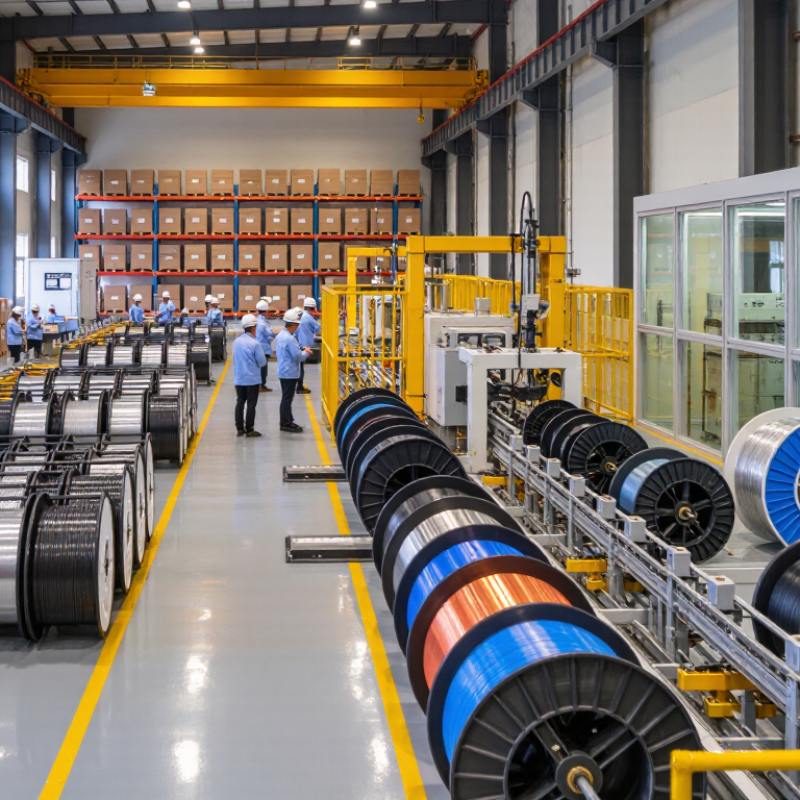
What Are the Top Coaxial Cable Manufacturers in China?

What Defines a Leading Coaxial Cable Manufacturer in China?

A leading coaxial cable manufacturer in China is defined by more than production volume. It begins with controlled materials, stable processes, and engineers who understand signal behavior. Copper purity, dielectric consistency, braid coverage, and jacket thickness directly affect attenuation and shielding. Small variations matter. During a factory assessment, buyers should review incoming-material records, calibration reports, and batch samples, not only polished product photographs. Reliable manufacturers can explain impedance control, connector compatibility, and performance across the required frequency range. They also document testing for insertion loss, return loss, tensile strength, temperature resistance, and aging. Clear reports build confidence.

Experience appears in practical details. Does the production team identify a loose braid before it becomes a field complaint? Can it adjust extrusion settings when a jacket shows uneven thickness? These responses reveal technical maturity. A capable supplier also maintains traceable lot numbers, controlled change procedures, and repeatable pre-shipment inspections. Independent testing can strengthen credibility when projects involve demanding infrastructure or communication systems. Yet no manufacturer is flawless. A strong partner admits failed samples, explains corrective actions, and welcomes reasonable audits. That honesty is more useful than exaggerated claims. Lead times, packaging, moisture protection, and after-sales communication deserve equal attention. A cable may pass a laboratory test but fail during careless installation. Manufacturers should provide usable specifications and installation guidance, while buyers should verify performance in their own environment. That shared responsibility is often overlooked.

China’s Major Coaxial Cable Manufacturers and Their Core Strengths

China’s major coaxial cable manufacturers serve telecom, broadcasting, security, and industrial markets. Their strengths differ considerably. Large integrated factories usually control copper drawing, dielectric foaming, shielding, jacketing, and testing in one plant. This improves batch consistency and delivery speed. Specialized RF producers focus on low attenuation, stable impedance, and high-frequency performance. These features matter in dense data networks and wireless infrastructure.

MarketsandMarkets’ 2024 outlook projects the global coaxial cable market to grow at roughly 6% annually. Grand View Research also identifies broadband expansion and network upgrades as important demand drivers. However, market estimates vary by product definition. The ranking is not perfectly fixed. A manufacturer with strong export volume may not lead in precision RF assemblies. Another supplier may perform better with short custom runs, connector fitting, or harsh-environment jackets. Technical documentation, rather than factory size, should guide selection.

Tips: Request test reports for attenuation, return loss, shielding effectiveness, and impedance. Check whether results cover the required frequency range. Ask for production samples before signing a large order. Inspect braid coverage, jacket uniformity, and connector pull strength. A reliable supplier should explain tolerances clearly and provide traceable batch records. Some factories still present impressive laboratory figures but offer weak after-sales support. That gap deserves careful review.

Key Coaxial Cable Products and Industry Applications

China’s leading coaxial-cable manufacturers compete through product coverage, testing discipline, and application-specific engineering. For buyers, the key question is not only who makes cable, but which cable survives the installation.

Common products include RG-series flexible cables, low-loss feeder cables, hardline cables, triaxial cables, and semi-rigid assemblies. RG cables suit cameras, wireless equipment, and laboratory connections. Low-loss feeder cables serve base stations, distributed antenna systems, and public transport networks. Hardline designs handle longer outdoor routes, where bending and moisture become serious risks. The China Ministry of Industry and Information Technology reported 4.25 million 5G base stations by the end of 2024. That scale supports continued demand for reliable RF feeder products.

Testing matters more than polished catalogs. IEC 61196-based evaluations should verify impedance, attenuation, return loss, shielding effectiveness, and connector performance. For video systems, stable 75-ohm behavior reduces signal reflections. For cellular networks, lower attenuation preserves link budgets across long routes. Manufacturers supplying industrial users should also provide bend-radius data, temperature ratings, flame performance, and traceable batch reports. Real installations expose a harder truth. Specifications alone can mislead. A cable may pass laboratory tests but fail after repeated bending, poor grounding, or water entry. Buyers should request sample testing, installation guidance, and independent verification before approving large orders. Low price is not proof of efficiency.

Key Coaxial Cable Product Classes and Typical Applications in China

The chart compares the nominal characteristic impedance of widely used coaxial cable product classes. 50-ohm cables are commonly used in wireless communications, radio-frequency systems and test equipment, while 75-ohm cables are widely used for broadcast video, CATV, satellite television and CCTV systems.

Manufacturing Standards, Testing Methods, and Quality Certifications

China’s leading coaxial cable manufacturers usually follow IEC 61196 standards for cable design and performance. Reliable factories also maintain documented process controls under ISO 9001. These controls cover conductor purity, dielectric thickness, shielding coverage, and jacket consistency. In production, operators measure impedance, capacitance, attenuation, and return loss at defined frequencies. Time-domain reflectometry can reveal connector faults, crushed sections, or uneven geometry. The results should be linked to batch numbers and retained for traceability.

Quality testing should continue beyond electrical performance. Manufacturers commonly perform tensile, bending, aging, moisture, and temperature-cycle tests. Flame behavior may also require separate verification for specific applications. Certifications such as RoHS, ISO 9001, or environmental management approvals can support purchasing decisions, but their scope must be checked carefully. A certificate is useful, not magical. It does not guarantee that every shipment is perfect. I have seen specifications look impressive while sampling records remained incomplete. That gap deserves attention.

Tips: Request recent test reports, calibration records, and a sample inspection plan before placing a large order. Compare measured attenuation with the declared value at the same frequency. Check whether the certificate covers the actual factory and cable construction. Ask how rejected reels are isolated and recorded. Small details often expose weak quality systems. Also review packaging, because damaged connectors or moisture exposure can reduce field performance before installation.

How to Compare Chinese Coaxial Cable Suppliers for Your Needs

When comparing Chinese coaxial cable suppliers, price should not lead the decision. Grand View Research estimates the global coaxial cable market at about USD 14 billion in 2023, with steady growth through 2030. That growth increases supplier choices, but not necessarily supplier quality. Ask for impedance data, attenuation curves, shielding effectiveness, conductor material, and operating temperature. A 50-ohm cable for wireless equipment cannot replace a 75-ohm cable for video systems.

Request samples from the same specification and test them under identical conditions. Check insertion loss at your actual frequency, not only at 1 MHz. Inspect braid coverage, jacket thickness, connector fit, and bend recovery. Small differences matter. MarketsandMarkets projects continued expansion in high-frequency connectivity, where signal loss and return loss become more sensitive. Suppliers should provide recent laboratory reports, calibration records, and batch traceability. ISO 9001 certification helps, but it does not prove every shipment is consistent.

Commercial details also deserve technical attention. Compare minimum order quantities, production lead times, packaging, warranty terms, and replacement procedures. Request a factory video or an independent audit when travel is difficult. Confirm compliance documents for RoHS, REACH, and applicable IEC requirements. Some quotations look attractive because copper content, testing, or packaging is reduced. I have seen specifications copied too quickly; that is a warning sign. Use a written comparison sheet, approve a pre-production sample, and keep one retained sample for future inspection. Mistakes happen. Document them early.

What Are the Top Coaxial Cable Manufacturers in China? - How to Compare Chinese Coaxial Cable Suppliers for Your Needs

Comparison Dimension Industry-Verified Reference Why It Matters Recommended Verification
Product category RG-series, CCTV coaxial, satellite coaxial, broadcast coaxial, low-loss RF cable, and semi-rigid cable Different constructions are designed for different frequencies, installation conditions, and signal-loss requirements. Request a product datasheet showing cable structure, frequency range, attenuation, shielding, and operating temperature.
Applicable standards Common references include IEC 61196, IEC 60332, RoHS, REACH, and relevant UL or CPR requirements where applicable Standards help define electrical performance, fire behavior, restricted substances, and market-access requirements. Check current certificates, test reports, issuing laboratories, certificate scope, and product-model consistency.
Conductor material Bare copper provides high conductivity; copper-clad steel is commonly used where mechanical strength and cost are priorities; copper-clad aluminum is lighter but has higher resistance. Conductor composition affects attenuation, flexibility, weight, current-carrying capability, and long-term reliability. Confirm conductor type, diameter, resistance per unit length, and material declaration through sampling or third-party testing.
Shielding construction Typical constructions include foil, braid, dual-shield, and tri-shield designs; shielding coverage varies by construction. Higher and more consistent shielding generally improves protection against electromagnetic interference and signal leakage. Review shielding coverage, transfer impedance, screening effectiveness, and test frequency rather than relying only on “high shield” wording.
Electrical performance Key specifications include characteristic impedance, attenuation, return loss, capacitance, velocity of propagation, and maximum operating frequency. A cable with the wrong impedance or excessive loss can cause reflections, reduced range, and unstable transmission. Match the cable’s impedance to the system, commonly 50 Ω or 75 Ω, and compare test data at the frequencies used in the application.
Jacket material and environment PVC, PE, LSZH, plenum-rated, outdoor-rated, UV-resistant, and flame-retardant options are available for different environments. The jacket determines resistance to sunlight, moisture, chemicals, fire, smoke, abrasion, and temperature variation. Specify indoor or outdoor use, direct burial, UV exposure, fire rating, minimum bend radius, and temperature range before quotation.
Dimensional consistency Important controls include conductor diameter, dielectric diameter, insulation concentricity, jacket thickness, and finished cable diameter. Stable dimensions support predictable electrical performance and reliable connector termination. Ask for production tolerances, inspection records, and dimensional results from the same batch as the supplied samples.
Manufacturing and quality control Mature production controls normally include conductor resistance testing, high-voltage testing, impedance testing, attenuation testing, and visual inspection. Documented controls reduce variation between production lots and help identify defects before shipment. Request an ISO 9001 certificate where applicable, a quality-control plan, batch test reports, and sample retention procedures.
Customization capability Common customization areas include impedance, conductor material, jacket color, printing, packaging, connector assembly, and cable length. Customization can improve installation efficiency and ensure compatibility with the customer’s equipment and regulations. Confirm minimum order quantity, tooling charges, sample approval process, drawing control, and change-notification procedures.
Minimum order quantity and lead time Stock products generally offer shorter lead times, while custom structures, special jackets, and connectorized assemblies require additional planning. Lead-time reliability is as important as the quoted production time for project scheduling. Obtain separate timelines for sampling, pilot production, standard orders, custom orders, and repeat orders.
Packaging and logistics Coaxial cable is commonly supplied on reels, drums, or coils, with packaging selected according to cable diameter, length, and transport method. Appropriate packaging helps prevent crushing, excessive bending, moisture ingress, and length discrepancies during shipment. Confirm reel dimensions, net and gross weight, moisture protection, shipping marks, documentation, and Incoterms.
Technical support Useful support includes cable selection, connector matching, installation guidance, test interpretation, and troubleshooting. Technical assistance lowers the risk of selecting a cable that meets a catalog specification but fails in the complete system. Evaluate response quality, drawing capability, engineering communication, and availability of pre-shipment documentation.
Total procurement value A meaningful comparison includes cable price, connectors, testing, packaging, freight, import duties, installation labor, and expected service life. The lowest unit price may create higher total costs if it causes signal loss, installation problems, returns, or premature replacement. Use a landed-cost calculation and compare suppliers using identical specifications, quantities, delivery terms, and acceptance criteria.

Note: Supplier performance should be assessed using current technical documents, verified samples, production-batch test reports, and application-specific requirements rather than price or marketing claims alone.