
Toll Free: 866.905.6744 | Local: 845.652.5250
Choosing the right Cross Slide Table is rarely a simple matter of comparing travel lengths. A compact table may look impressive, yet flex under a modest cutting load. Another model may offer excellent precision but lack the adjustment range your fixture requires.
This guide, “7 Tips for Choosing the Right Cross Slide Table,” focuses on practical selection decisions. It examines load capacity, travel distance, rigidity, backlash, mounting patterns, operating environment, and repeatability. Each detail matters. Small errors become expensive.
W. Edwards Deming, a respected quality expert, said, “In God we trust; all others must bring data.” That principle applies directly here. Check measured accuracy, not only catalog claims. Request test results when possible. Compare radial and axial loads separately. Confirm whether stated precision applies before or after installation.
In real workshops, I have seen buyers choose a table because its handwheel felt smooth. Later, the table developed play during drilling. That choice looked reasonable. It was not fully evaluated.
A reliable Cross Slide Table should match the machine, workpiece, tooling, and operator. Consider steel or aluminum construction, lead-screw design, lubrication access, and T-slot compatibility. Think about dust, coolant, and daily adjustment frequency.
Some requirements remain uncertain. You may not know the final fixture size today. Leave practical adjustment room, but avoid buying excessive capacity without purpose. Larger tables often add weight and cost.
The following seven tips will help you question specifications carefully, identify hidden compromises, and select a table that performs consistently in real working conditions.
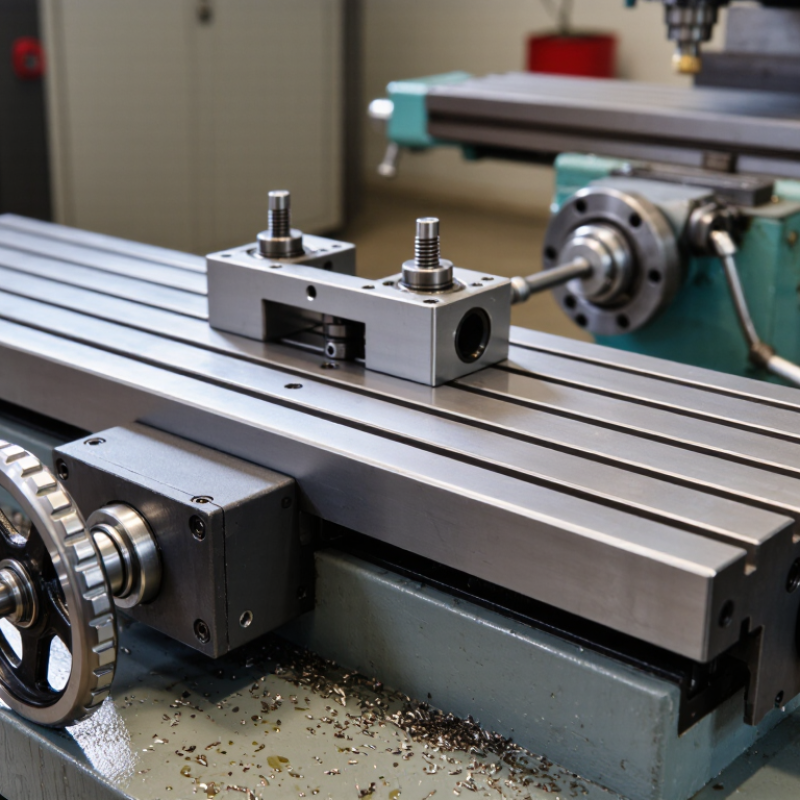
A cross slide table provides controlled movement along two perpendicular axes. Compact manual tables often use dovetail slides, while ball-bearing designs support smoother, lighter motion. Some models add a vertical Z-axis, creating XYZ positioning.
Tip 1: Identify the required axes before comparing size or price. A two-axis table may suit drilling and inspection. A three-axis table offers greater flexibility, but it also increases height and setup complexity.
Travel range depends strongly on table size. Small precision tables commonly offer 25–50 mm per axis. Medium tables often provide 75–150 mm. Larger industrial versions may reach 200–300 mm, though rigidity can decrease near maximum extension.
Tip 2: Measure the actual working envelope, not only the table’s travel. A 100 mm range may become impractical when clamps, tooling, and safety clearance consume space. This is easy to overlook.
Tip 3: Match the slide type to the load and adjustment speed. Dovetail slides usually resist vibration well and feel stable under heavier loads. Ball-bearing slides can move more freely, but contamination may affect smoothness.
Tip 4: Check axis backlash, lead screw pitch, and locking points. Fine adjustment matters during alignment. I would also test the handwheel position in the real workspace.
Specifications can look excellent, yet an awkward handle makes repeated adjustments tiring. Travel figures are useful, but they are not the whole decision.
7 Tips for Choosing the Right Cross Slide Table
Match Load Capacity to Workpiece Weight Using Manufacturer Ratings
When selecting a cross slide table, start with the manufacturer’s rated load capacity. Do not match the rating to the workpiece weight alone. Cutting forces, clamps, tooling, and movement can add significant stress. A 20-kilogram workpiece may create much higher loads during rapid positioning or interrupted cuts.
Tip: Weigh everything.
I once underestimated a fixture by several kilograms. The table moved, but accuracy suffered near the end of its travel. That experience changed my checking process. I now calculate the complete moving mass and compare it with the manufacturer’s static and dynamic ratings. Dynamic capacity matters when the table accelerates, stops, or changes direction. Static capacity matters when the load remains still.
Leave a practical safety margin. Many engineers use a margin of 25% to 50%, depending on vibration, duty cycle, and machining forces. However, the correct allowance depends on the manufacturer’s testing conditions. Read the load rating notes carefully. Some ratings assume a centered load, while your workpiece may sit toward one edge.
Tip: Check the center of gravity.
An offset load can produce twisting forces, even when the total weight seems acceptable. Review travel position, mounting orientation, and support spacing before installation. I sometimes find that a smaller table with better support performs more reliably than a larger table used near its limit. That is not always obvious. Recheck the figures before ordering.
| Tip | Selection Criterion | Example Workpiece Weight | Recommended Design Factor | Minimum Catalog Load Rating | What to Verify in the Manufacturer Rating |
|---|---|---|---|---|---|
| 1 | Start with the complete moving load, not only the workpiece. | 8 kg 17.6 lb | 1.5 × static load | 12 kg 118 N | Add the fixture, vise, tooling, cables, and any other components carried by the slide before comparing the total with the catalog rating. |
| 2 | Allow capacity for moderate acceleration and deceleration. | 15 kg 33.1 lb | 1.5 × static load | 22.5 kg 221 N | Check whether the published value applies to moving operation or only to a stationary, centrally positioned load. |
| 3 | Increase the margin when cutting forces or vibration are present. | 25 kg 55.1 lb | 1.5 × static load | 37.5 kg 368 N | Review allowable operating loads, shock limitations, and the recommended service conditions for milling, drilling, grinding, or intermittent cutting. |
| 4 | Check the load center and overhang from the slide surface. | 40 kg 88.2 lb | 1.5 × static load | 60 kg 589 N | A load positioned away from the guide center creates a moment. Compare the calculated moment with the manufacturer’s allowable pitch, yaw, and roll moment ratings. |
| 5 | Match the rating to the actual orientation of the table. | 60 kg 132.3 lb | 1.5 × static load | 90 kg 883 N | Confirm whether the rating is specified for horizontal, vertical, or inverted installation. Vertical applications may also require a brake, counterbalance, or equivalent holding method. |
| 6 | Consider repeated motion and expected service life. | 100 kg 220.5 lb | 1.5 × static load | 150 kg 1,472 N | Use the manufacturer’s dynamic load, duty-cycle, speed, acceleration, and rated-life information rather than relying only on the maximum static capacity. |
| 7 | Select the next available rating above the calculated requirement. | 150 kg 330.7 lb | 1.5 × static load | 225 kg 2,207 N | Choose a catalog model whose published load and moment ratings exceed the calculated values after considering installation direction, overhang, speed, and process forces. |
Choosing a cross slide table starts with evidence, not a polished specification sheet. Ask for ISO 230-2 positioning data from a documented test. Confirm the measured axis, travel length, sampling points, feed rate, and environmental conditions. These details matter.
Look for both positioning accuracy and repeatability. Accuracy shows how closely the table reaches a commanded position. Repeatability shows how consistently it returns there. Check measurements from both travel directions, because backlash can appear when motion reverses. A table may repeat well in one direction yet perform poorly during bidirectional work. That difference is easy to miss.
Review the data across the full travel, not only near the center. Check whether thermal drift was measured after warm-up. A workshop can change several degrees during a long shift. Small temperature changes may affect tight fits. Also compare the reported uncertainty and test method, rather than trusting one impressive maximum value. ISO 230-2 results support comparison, but they do not predict every real application.
Match the table to your process. Fine inspection may need stable repeatability, while drilling may depend more on stiffness and load capacity. Consider guide preload, mounting flatness, lubrication, and operator technique. These practical factors can reduce performance. I have seen accurate equipment underperform after uneven mounting. That is a useful reminder: published data guides the decision, but installation still deserves careful measurement.
Choosing a cross slide table begins with the drive system, not the catalog photo. Pitch determines movement per revolution and strongly affects positioning resolution. A fine pitch improves control, but it usually reduces travel speed. A coarse pitch moves faster, though small adjustments become less precise.
Check the required speed under the real load. Do not rely only on the no-load rating. Add the workpiece, tooling, and acceleration forces. Then inspect backlash specifications, especially when the table changes direction repeatedly. Low backlash supports accurate reversal, but it may require careful adjustment and regular maintenance. Measure under load. The result can differ from a factory test.
Lead screws suit moderate speeds and cost-sensitive designs. Ball screws typically offer smoother motion and lower friction, but installation alignment becomes more demanding. Consider load capacity, duty cycle, lubrication access, contamination, and available motor torque. A compact table may fit neatly, yet provide too little stiffness during cutting. That mistake is common.
Review repeatability separately from accuracy. They are not identical. Confirm whether specifications use millimeters, inches, or angular movement, and ask how temperature affects performance. In practice, I would test several reversal cycles with a dial indicator before final selection. I have also learned that a tighter specification is not automatically better if the application cannot maintain alignment. Leave adjustment access around the drive, and document the expected service conditions before ordering.
Choosing the right cross slide table starts with its mounting dimensions. Measure hole spacing, bolt size, table height, and available travel before comparing models. A few millimeters can create alignment problems. I once overlooked a counterbore depth and needed extra spacers during installation. That mistake was avoidable.
Check the material against the working environment. Hardened steel suits repeated loads, while aluminum can reduce moving mass. Consider corrosion, vibration, temperature, and the weight of the workpiece. Confirm the rated load in both directions, not only vertically. Travel should include usable clearance, not just the advertised maximum. Small details matter.
Lubrication and service access also deserve attention. Look for accessible grease points, protected ways, replaceable wear parts, and clear maintenance instructions. Some tables feel smooth when new but become rough under dust or poor lubrication. Ask how often lubrication is required and which lubricant is compatible. Service time affects operating cost. I would also inspect backlash and repeatability under real load, because catalog figures may not reflect your setup. Perfect selection is unlikely; careful verification is better.