
Toll Free: 866.905.6744 | Local: 845.652.5250
Choosing among the top steel structure manufacturers for global buyers requires more than comparing prices. It requires practical evidence.
A reliable manufacturer should demonstrate documented project experience, qualified engineers, controlled fabrication, and consistent delivery performance. Buyers should examine welding procedures, material certificates, dimensional inspections, coating systems, and independent quality reports. These details matter when columns arrive at a busy construction site, with cranes waiting and installation crews already scheduled.
Fazlur R. Khan, a pioneering structural engineer, said, “The skyscraper is a product of technology.” His observation remains relevant today. Modern steel structure projects depend on engineering accuracy, advanced software, and disciplined manufacturing. However, technology alone does not guarantee a successful result. People still interpret drawings, check connections, manage tolerances, and solve unexpected problems.
This guide evaluates manufacturers through several practical lenses. They include design capability, production capacity, international standards, supply-chain control, packaging, shipping experience, and after-sales support. It also considers whether a supplier can adapt designs without weakening performance or creating avoidable delays.
Look beyond polished websites.
A factory tour, recent client references, and sample inspection records may reveal more than promotional claims. Buyers should also confirm applicable standards, such as Eurocodes, AISC requirements, or other project-specific rules. Local engineering approval remains essential, even when the manufacturer has strong global experience.
No ranking is perfect. Supplier performance can change with management, workload, materials, or regional logistics. That limitation deserves attention. The strongest choice is not always the cheapest or largest company. It is the manufacturer that communicates clearly, documents its work, and accepts responsibility when details require correction.
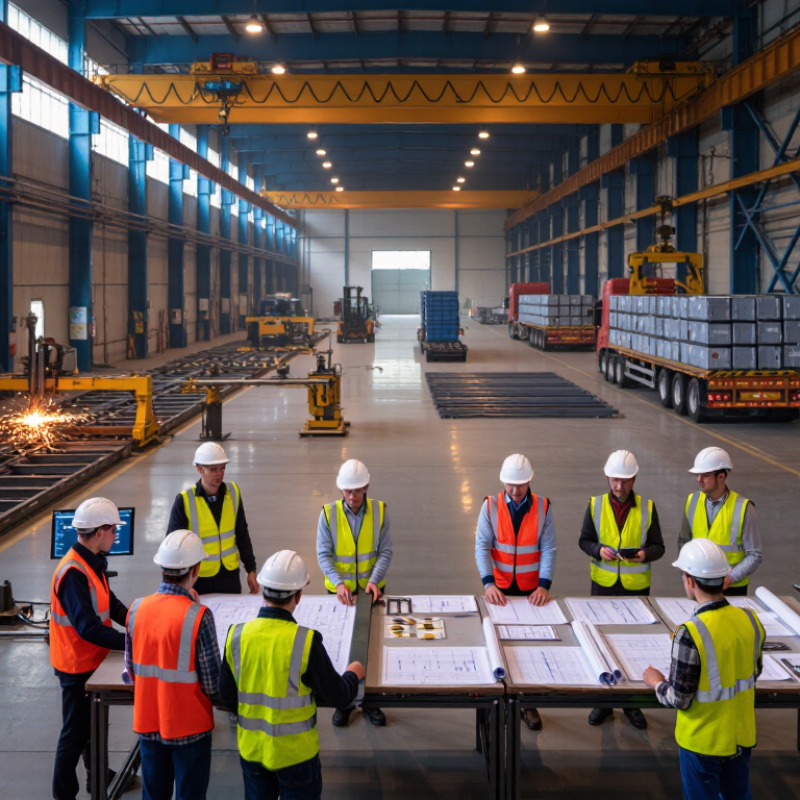
Steel structure manufacturers now function as technical partners, not merely fabricators. They convert structural drawings into certified components, coordinated deliveries, and safer site operations. Their responsibilities often include connection design, material traceability, welding procedures, corrosion protection, and installation guidance.
Scale makes this role significant. The World Steel Association reported approximately 1.89 billion tonnes of crude steel production worldwide in 2023. Yet production volume alone does not prove capability. Global buyers should examine mill certificates, weld inspection records, bolt-tension reports, and factory acceptance procedures. A manufacturer with practical export experience can also anticipate container limits, port delays, local codes, and site-access problems.
Carbon performance adds another responsibility. The International Energy Agency estimates steel production creates around 2.6 gigatonnes of direct CO2 emissions annually, or roughly 7% of global energy-related emissions. Manufacturers can reduce project impact through efficient detailing, recycled-content verification, optimized member sizes, and lower-emission production routes. These claims require evidence, not attractive wording. Environmental Product Declarations and third-party audits provide stronger proof.
Small details matter. A missing coating record can delay erection. An unclear connection drawing can create expensive rework. No supplier is perfect, and procurement teams should question optimistic schedules and vague sustainability promises. The strongest manufacturers communicate limitations early, document decisions clearly, and support engineers after shipment. Their value is measured on the construction site, where drawings become bolted frames under real weather and time pressure.
Regional crude steel production indicates the scale of the industrial ecosystem that supports steel structure manufacturing, including material sourcing, fabrication capacity, and international project supply. Asia and Oceania represented the largest production base in 2023, while Europe, North America, and other regions maintained significant capacity for global construction markets.
Source: World Steel Association, “World Steel in Figures 2024.” Values are approximate crude steel production volumes for 2023, measured in million tonnes.
Choosing a steel structure supplier requires more than comparing quoted tonnage or factory photographs. International buyers should verify engineering competence, production controls, and accountability before signing.
Ask for project references with similar spans, loads, climate exposure, and installation conditions. Request stamped calculations, connection details, material certificates, and welding procedure records. Documents matter. Confirm the supplier can design against the project’s governing building codes. Check how revisions are controlled when site conditions change.
Factory assessment should focus on measurable evidence, not polished presentations. Inspect plate identification, cutting accuracy, weld inspections, dimensional checks, and coating thickness records. A clear traceability system should link each member to its heat number and inspection report. Ask whether independent inspectors can witness critical tests. That adds confidence.
Also evaluate packaging, corrosion protection, loading plans, and delivery terms. A delayed frame can stop cranes, crews, and concrete work. The cheapest offer may become expensive at the port.
Communication is a technical criterion, not a courtesy. Measure response times, drawing clarity, language capability, and escalation procedures. Reliable suppliers explain exclusions instead of hiding them in small print.
Still, no supplier is flawless. A strong review should record open risks, uncertain tolerances, and assumptions needing confirmation. I would not approve a supplier solely because its sample building looks impressive. Real reliability appears in evidence, corrective action, and consistent delivery under pressure.
Steel structure manufacturing is concentrated in several regions, each with distinct strengths. East Asian producers often provide large fabrication capacity, automated welding, and competitive production schedules. Their facilities commonly handle warehouse frames, bridge components, and modular industrial buildings.
European manufacturers are recognized for strict engineering controls and detailed compliance procedures. They often support complex connections, demanding tolerances, and energy-efficient building systems. North American facilities typically combine structural engineering with project management, helping buyers coordinate design, fabrication, and site installation. South Asian producers can offer flexible customization and labor-intensive fabrication for mid-sized projects.
Capabilities matter more than location alone. Reliable suppliers should demonstrate material traceability, weld inspection records, dimensional reports, and corrosion protection methods. Buyers should review cutting accuracy, plate thickness limits, lifting capacity, and monthly output before signing a contract. A clean factory is useful, but documented process control matters more.
Factory visits can reveal practical details, such as organized steel storage, calibrated testing equipment, and clearly marked production zones. However, one visit cannot prove consistent performance. That assumption needs testing. Independent inspections, sample drawings, and staged approvals reduce avoidable risk. Delivery speed also depends on port access, packaging quality, and local installation conditions, not only factory capacity.
For global buyers, a steel structure manufacturer should prove quality through controlled documents, not attractive photographs. The World Steel Association reported global crude steel production at about 1.89 billion tonnes in 2023. That scale makes traceability essential. Each beam should connect to a heat number, mill test certificate, and approved material grade. Experienced procurement teams also check ISO 9001 quality systems, ISO 3834 welding controls, and EN 1090 or AWS D1.1 compliance where applicable.
Production discipline matters on the factory floor. Inspectors should verify steel thickness before cutting. Welding procedures need qualification records, trained operators, and visible inspection points. Ultrasonic or magnetic testing may detect defects hidden beneath clean paint. Dimensional checks should confirm hole positions, member lengths, flange alignment, and coating thickness. The ISO Survey recorded more than 1.2 million ISO 9001 certificates worldwide in 2022. Certification is useful, but it does not guarantee perfect workmanship. That distinction is often missed.
Reliable manufacturers maintain batch-level records from incoming steel to final loading. They photograph critical joints, mark components clearly, and protect machined surfaces during transport. Factory acceptance inspections can include sampling plans, weld reports, calibration certificates, and nonconformance logs. Some suppliers treat paperwork as decoration. That is a warning sign. A stronger evaluation compares certified procedures with actual production evidence, including rejected parts and corrective actions. No process is flawless; even experienced factories can overlook a small dimensional error. Honest reporting, fast correction, and independent inspection usually reveal more than polished sales language.
| Evaluation Dimension | Typical Quality Benchmark | Applicable Standard or Reference | Production or Inspection Evidence | Recommended Buyer Verification |
|---|---|---|---|---|
| Quality management | Documented quality-management system covering purchasing, fabrication, inspection, nonconformity control, and corrective action. | ISO 9001:2015 | Valid certificate issued by an accredited certification body; controlled procedures and internal audit records. | Check certificate scope, validity, site address, and certification-body accreditation. |
| Welding quality system | Qualified welding personnel, approved welding procedures, traceable consumables, and controlled welding parameters. | ISO 3834-2; AWS D1.1/D1.1M where specified | Welding procedure specifications, procedure qualification records, welder qualification records, and weld maps. | Review qualifications against the selected material, welding process, thickness, and project code. |
| Execution class capability | Production controls matched to the structural risk, design requirements, and installation environment. | EN 1090-1 execution classes EXC1–EXC4 | Factory production control documentation, inspection plans, traceability records, and declaration of performance where applicable. | Confirm the required execution class with the design engineer before contracting. |
| Structural steel grades | Common low-alloy structural grades include S275 and S355 under European specifications; ASTM A36 and ASTM A572 Grade 50 are also widely used. | EN 10025-2; ASTM A36/A572 | Mill test certificates showing chemical composition, mechanical properties, heat number, and product dimensions. | Verify that the specified grade, thickness, impact requirement, and delivery condition match the design. |
| Material traceability | Traceability maintained from incoming steel through cutting, assembly, welding, coating, and dispatch. | EN 10204 inspection documents; project quality plan | Heat numbers transferred to components, material registers, cutting lists, and final inspection records. | Request a sample traceability chain for one finished member. |
| Dimensional accuracy | Fabricated members controlled for length, straightness, squareness, hole position, camber, and assembly fit-up. | EN 1090-2; approved fabrication drawings and project tolerances | Calibrated measuring equipment, dimensional inspection reports, fit-up checks, and survey records. | Require a signed dimensional report for critical assemblies and connection zones. |
| Weld acceptance | Visual inspection of welds, with additional non-destructive testing based on design category and specification. | ISO 5817; ISO 17637; ISO 17635 | Visual inspection reports plus magnetic-particle, dye-penetrant, ultrasonic, or radiographic test reports when required. | Confirm test method, inspection percentage, acceptance level, and independent inspector involvement. |
| Surface preparation | Surface cleanliness and roughness selected according to the coating system and exposure category. | ISO 8501-1; ISO 8503; ISO 12944 | Abrasive-blasting records, surface profile measurements, dust checks, and soluble-salt checks where specified. | Specify preparation grade, profile range, coating system, and maximum time before priming. |
| Protective coating | Coating thickness and curing conditions controlled for the intended atmospheric or industrial environment. | ISO 12944; ISO 19840 | Dry-film-thickness readings, environmental logs, paint batch records, and repair records. | Review the complete paint data sheet and require readings at agreed inspection locations. |
| Hot-dip galvanizing | Zinc coating applied after suitable fabrication, cleaning, venting, and drainage preparation. | ISO 1461 | Visual inspection, coating-thickness measurements, repair records, and galvanizing certificate. | Confirm minimum local and mean coating requirements for the applicable steel thickness. |
| Cutting and drilling | CNC cutting, automated drilling, or controlled manual processes selected according to component complexity and tolerance. | Approved shop drawings; EN 1090-2 or project specification | CNC program records, tool calibration, hole-diameter checks, edge-condition checks, and first-piece inspection. | Ask for inspection records covering bolt-hole diameter, spacing, edge distance, and burr removal. |
| Assembly and fit-up | Trial assembly or controlled fit-up for complex frames, trusses, built-up members, and connection interfaces. | Approved fabrication drawings; project inspection and test plan | Fit-up checklists, temporary-connection records, bolt installation records, and photographic evidence. | Identify which assemblies require factory trial fitting before shipment. |
| Factory acceptance inspection | Final inspection completed before packing, including dimensions, welds, coatings, markings, and documentation. | Project inspection and test plan; contract quality requirements | Signed release note, punch-list closure, nonconformance reports, and final manufacturing dossier. | Define hold points and witness points for buyer or third-party inspection. |
| Packing and logistics | Members protected against impact, moisture, corrosion, deformation, and identification loss during transport. | Approved packing plan; shipping and lifting requirements | Packing lists, piece marks, lifting points, container-loading photographs, and shipping-weight records. | Check that piece marks correspond to erection drawings and packing lists. |
| Technical documentation | Complete document package supplied in the agreed language and format before or with shipment. | Contract document register; applicable national or project code | Approved drawings, material certificates, welding records, inspection reports, coating records, packing lists, and certificates of conformity. | Include document-submittal milestones and approval responsibilities in the purchase contract. |
Selecting the right steel structure manufacturer starts with evidence, not impressive promises. Ask how many similar projects the manufacturer has completed in your climate and industry. Request project references, fabrication photos, and signed quality records. Experience should be visible.
Check the engineering process carefully. A reliable manufacturer should provide stamped calculations, detailed shop drawings, and material traceability. Ask how welders are qualified and how steel thickness, coating, and bolt grades are inspected. Details matter. Confirm that designs follow the codes required at your project location. Local wind, snow, seismic, and fire conditions can change the entire structure.
Production capacity also affects risk. Visit the factory if possible, or arrange a live quality inspection. Look for organized steel storage, calibrated measuring tools, and clear welding procedures. Ask about delivery milestones, packaging, site guidance, and corrective action when defects appear. A low quotation may hide weaker coatings, unclear exclusions, or unrealistic transport schedules. Read every line.
Communication is another practical test. During early discussions, note whether engineers explain assumptions or simply agree with every request. Good manufacturers raise difficult questions before fabrication begins. No supplier is perfect. Even a strong technical team can misjudge a rushed change or underestimate local installation challenges. Keep written approvals, inspection points, and payment conditions in the contract. Choose a partner whose evidence remains dependable after the sales conversation ends.