How to Choose Advertising Flag Hardware in 2026?
Choosing the right Advertising Flag Hardware in 2026 starts with the place your flag will stand. A lightweight pole that works beside an indoor reception desk may wobble on an exposed sidewalk. The base, pole, crossbar, and fabric attachment all affect how easily the display can be assembled and how steadily it stands. Small details matter.
Start by checking the flag’s shape and dimensions, then match the hardware to the surface and expected conditions. A flat base may suit a smooth showroom floor, while a ground spike is designed for suitable soil. For windy or frequently used locations, consider the manufacturer’s guidance on compatible bases, setup, and care rather than relying on appearance alone. Compare materials, joint construction, replacement-part availability, and packed size if the display travels between events. A compact kit can save storage space, but a small base may not be appropriate for every setting.
There is no single best kit for every buyer. Product descriptions can omit practical details, and a low price does not always mean lower ownership costs. Check measurements and compatibility before ordering, and ask the supplier for specifications when they are unclear. This guide outlines the main hardware options, the questions worth asking, and the trade-offs that can shape a dependable choice.
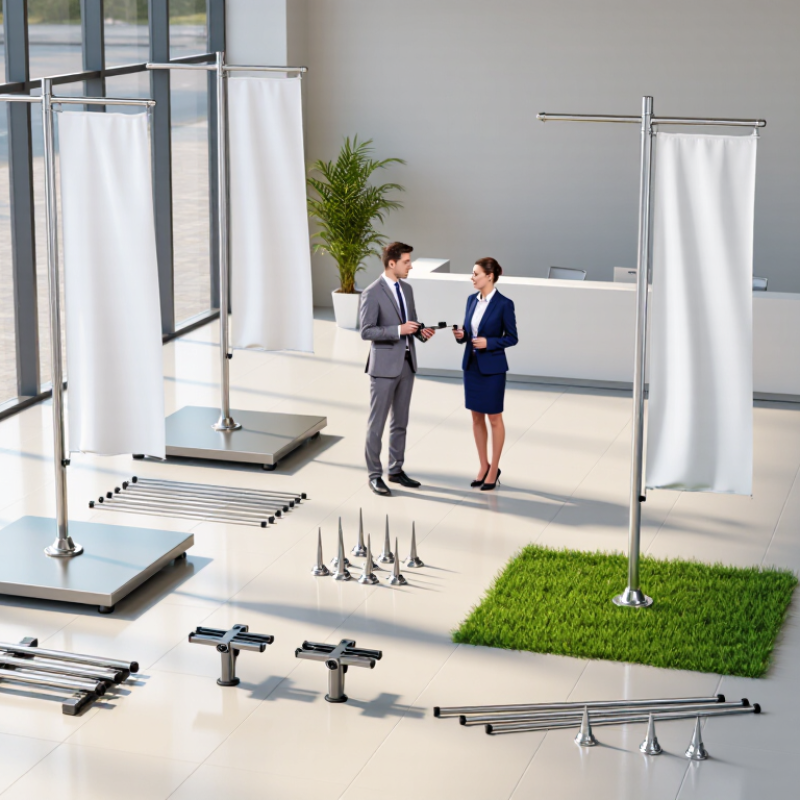
Define Flag Size, Shape, and Site Exposure Before Choosing Hardware
Before choosing advertising flag hardware, measure the finished flag, not just the artwork file. Record its height, widest point, and sleeve or pocket dimensions. A tall feather flag needs a different pole curve and tension than a compact rectangular flag. Teardrop shapes also rely on a frame that keeps the fabric taut. Small details matter. If the pole is too short, the fabric may drag or bunch near the ground.
Next, assess the exact display site. Note whether the flag will stand on pavement, grass, or a soft lawn, and check for nearby walls that can funnel gusts. A weighted base may suit a level entrance, while a ground stake can work better in firm soil. Neither option fits every location. Wind exposure changes through the day, too, so a sheltered morning does not tell the whole story.
Match the hardware to both the flag dimensions and the site’s conditions. Check the hardware supplier’s stated size and wind guidance, and leave enough clearance for nearby doors, branches, and foot traffic. A common planning miss is measuring the display spot but overlooking how much space the flag needs to rotate. Recheck after installation. A slightly awkward fit can be easy to miss on a drawing.
Estimate Wind Pressure: q ≈ 0.613V² Pa at 1.225 kg/m³
For advertising flag hardware, begin with wind pressure, not pole height alone. Using air density of 1.225 kg/m³, q ≈ 0.613V² Pa, with V measured in metres per second. At 15 m/s, q is about 138 Pa; at 25 m/s, it rises to 383 Pa. Small numbers climb fast. A 0.6-by-2.4-metre flag presents 1.44 m² of area, so 25 m/s gives roughly 551 N of pressure force before drag, gust, and fabric movement are considered. That is not the whole load.
Treat this calculation as a screening estimate, not a hardware rating. ASCE/SEI 7-22 accounts for site wind speed and exposure conditions in structural wind design; NIST Technical Note 1908 explains how ASCE wind provisions apply pressure coefficients and other factors. These details matter near open coastlines, between buildings, or on exposed corners, where local flow can differ sharply from a sheltered yard. Compare the resulting design load with the flag’s projected area, pole joints, base plate, anchors, and ground strength. A heavier base may help, but it cannot fix a weak connection. I would also check the manufacturer’s stated limits against the actual installation; that detail is easy to overlook.
Compare Metal Corrosion (ISO 9227) and Fabric Lightfastness (ISO 105-B02)
Choosing advertising flag hardware in 2026 means checking test evidence, not just a polished finish. ISO 9227 exposes metal samples to a controlled salt mist, helping compare corrosion resistance. It cannot predict an exact outdoor lifespan. A bracket may perform differently near coastal spray, road salt, or trapped rainwater. Ask which material and coating were tested, for how long, and against what acceptance criteria. Inspect seams and fasteners too. Small details matter.
Fabric needs separate evidence. ISO 105-B02 assesses colour fastness to artificial light, commonly using xenon-arc exposure. Compare ratings from the same method and test conditions; higher ratings generally indicate better resistance to fading. Lab results are not promises of identical outdoor performance. Sun angle, display hours, cleaning, and printing all affect colour. I would not choose by rating alone. Keep a fabric sample for later comparison.
Tips: Request test reports for the actual hardware finish and flag fabric, not merely similar materials. Check the sample after exposure, and consider your local weather. Tests help narrow choices, but they do not replace practical inspection.
How to Choose Advertising Flag Hardware in 2026?
Compare Metal Corrosion (ISO 9227) and Fabric Lightfastness (ISO 105-B02)
The chart shows illustrative specification checkpoints, not measured product results or ISO pass limits. ISO 9227 covers salt spray corrosion testing; the test duration and acceptance criteria are set by the relevant specification. ISO 105-B02 assesses colour fastness to artificial light using Blue Wool references, graded from 1 (low) to 8 (high). These are different measures and should not be compared numerically.
Verify Mounting Stability, Inspection Needs, and Manufacturer Wind Ratings
Choosing advertising flag hardware in 2026 starts with the ground beneath it. A pole that feels secure indoors may wobble on a paved forecourt or loosen in soft soil. Match the base, bracket, or ground spike to the surface and expected foot traffic. Check that clamps hold the pole without crushing it, and look for movement after installation. Small shifts matter.
Inspection should be practical and repeatable. Before use, check bolts, welds, locking pins, and fabric contact points for looseness, cracks, rust, or sharp wear. After strong winds, inspect again. It can be easy to skip this when a display looks fine, but hidden movement often shows up at the mounting point first. Manufacturer wind ratings are useful only when you know the tested setup, flag size, pole height, and exposure conditions. Ask for that information in writing. A rating for one configuration may not apply to yours.
Tips: Set a recurring inspection reminder. Tighten hardware to the maker’s instructions, not by guesswork. If the flag twists, the base shifts, or a fastener keeps loosening, stop using the setup until you find the cause. A little inconvenient, yes, but safer than trusting a number without context.