
Selecting the right Acrylic Impact Modifier for PVC in 2026 is not just a matter of comparing product names. PVC parts face different stresses, from cold-weather knocks on outdoor profiles to repeated handling of rigid fittings. A modifier that performs well in one formulation may not deliver the same result in another. That matters.
This guide examines how acrylic impact modifiers can help improve toughness while preserving the properties that make PVC useful. Key considerations include impact strength, processing behavior, compatibility with the PVC formulation, weatherability, and the finished product’s appearance. Small details count. A change in melt behavior, for example, can affect extrusion consistency, surface quality, and production waste. The best choice depends on the application, equipment, and balance of properties required.
A supplier’s technical data sheet is a useful starting point, not a complete answer. Test results should be reviewed alongside recommended loading levels and processing conditions, then checked in representative production trials. Results can vary with resin grade, stabilizers, fillers, and processing settings. There is no universal winner. This article offers a practical framework for comparing options and asking suppliers focused questions. It also recognizes a limitation: published data may not mirror your factory conditions. Careful trials remain essential before changing a proven PVC formulation.
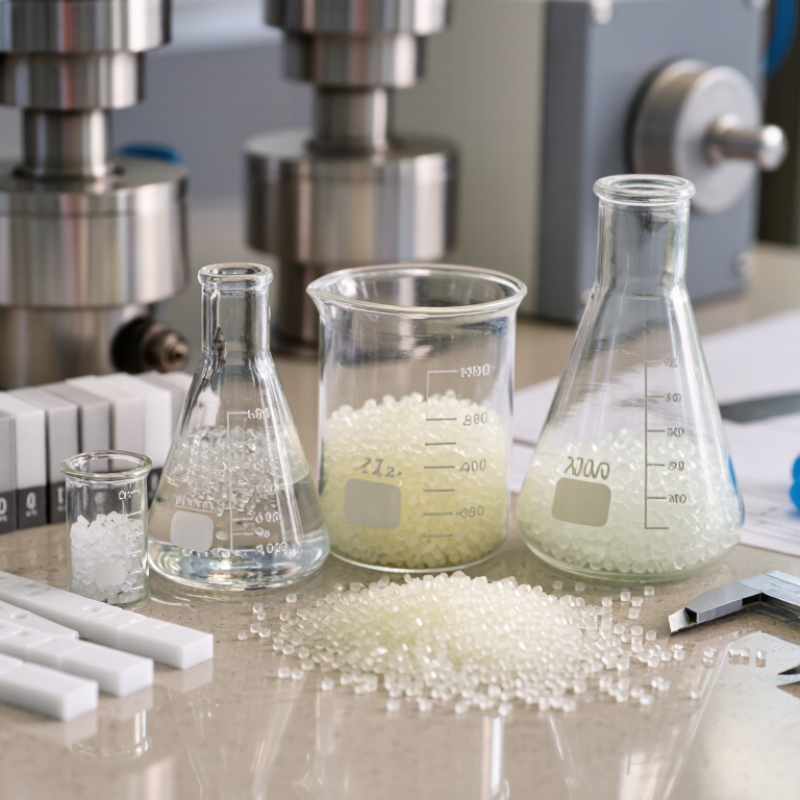
Acrylic impact modifiers are engineered additives that help rigid PVC withstand sudden blows without cracking. Most use a rubbery acrylic core surrounded by a harder polymer shell. During impact, the core deforms and helps trigger localized movement in the PVC matrix, spreading energy instead of letting one sharp crack travel through the part. In practice, the modifier must disperse evenly; poorly mixed material can leave weak spots around a cut edge or molded corner. Small details matter.
The PlasticsEurope report Plastics – the Fast Facts 2023 estimates global plastics production at 400.3 million tonnes in 2022. That figure gives market context, not proof of PVC modifier performance. Performance should be checked in the intended formulation and part geometry, using relevant impact testing such as ISO 179 or ASTM D256. Compare results at the same temperature and specimen thickness, and inspect failure mode as well as impact strength. A higher reading is useful, but it may not predict cold-weather service or long-term outdoor exposure. I would be cautious here: a modifier can improve impact resistance while changing stiffness, processing behavior, or surface appearance. There is no single “best” choice for every PVC application.
Acrylic impact modifiers are typically core–shell polymers: a rubbery acrylic-rich core absorbs impact energy, while a compatible outer phase helps the particles disperse in the PVC matrix. The comparison below is a general guide to modifier families, not a ranking of specific products.
| Modifier family | How it improves impact strength | Weathering and UV suitability | Common PVC application fit | Main selection considerations |
|---|---|---|---|---|
| Acrylic impact modifier (AIM) | Core–shell particles deform under stress and help dissipate impact energy, reducing the tendency for cracks to initiate or spread. | Generally a strong choice for outdoor rigid PVC because acrylic chemistry offers good resistance to UV exposure and weathering. | Window profiles, siding, exterior trim, and other rigid PVC products where impact performance and outdoor durability are both important. | Consider impact performance at the service temperature, fusion and processing behavior, surface appearance, and the required balance of toughness and stiffness. |
| MBS impact modifier (methacrylate–butadiene–styrene) | Rubbery butadiene-containing particles help absorb impact energy and can improve toughness in rigid PVC. | Usually less suitable for prolonged outdoor exposure than acrylic modifiers because the butadiene phase is more vulnerable to UV and weathering. | Indoor or protected rigid PVC products, including applications where clarity or a particular balance of impact performance and appearance is needed. | Assess UV exposure, transparency requirements, operating temperature, and compatibility with the specific PVC formulation. |
| Chlorinated polyethylene (CPE) | Elastomeric CPE domains improve toughness by deforming and helping to dissipate stress in the PVC compound. | Weathering performance depends on the CPE grade, stabilizer package, and full formulation; outdoor suitability should be confirmed by testing. | Rigid PVC products such as pipes, profiles, and siding, where a cost-effective impact-modification route may be considered. | Check processing and fusion behavior, low-temperature impact needs, surface requirements, and compatibility with other additives. |
| ABS-based modifier (acrylonitrile–butadiene–styrene) | The rubber phase contributes impact absorption, while the rigid phases contribute strength and stiffness in compatible blends. | Typically not the first choice for long-term outdoor exposure unless the formulation is specifically designed and validated for it. | Selected indoor PVC blends and products where the required mechanical balance and processing conditions suit the formulation. | Confirm compatibility, heat and weathering requirements, processing stability, and the properties of the finished blend. |
| Practical screening criteria | Compare candidate formulations using the same PVC resin, stabilizer package, processing conditions, and test method. Evaluate notched impact strength at relevant temperatures, weathering where applicable, tensile or flexural properties, surface quality, and processability. The best choice depends on the end-use requirements rather than modifier family alone. | |||
Note: These are general material-family comparisons. Actual results vary with modifier grade, dosage, PVC resin, stabilizers, processing conditions, specimen preparation, and test method. Confirm performance using application-specific testing.